
Imagine being able to control your phone or computer just by thinking. You don't need to type anything or speak a single word. You simply imagine moving a cursor, and the computer responds. Sounds like something from a science-fiction movie, right? But brain-computer interface technology is making this increasingly possible. Companies such as Neuralink are developing brain implants that could help people with paralysis communicate, use computers, and regain some independence.
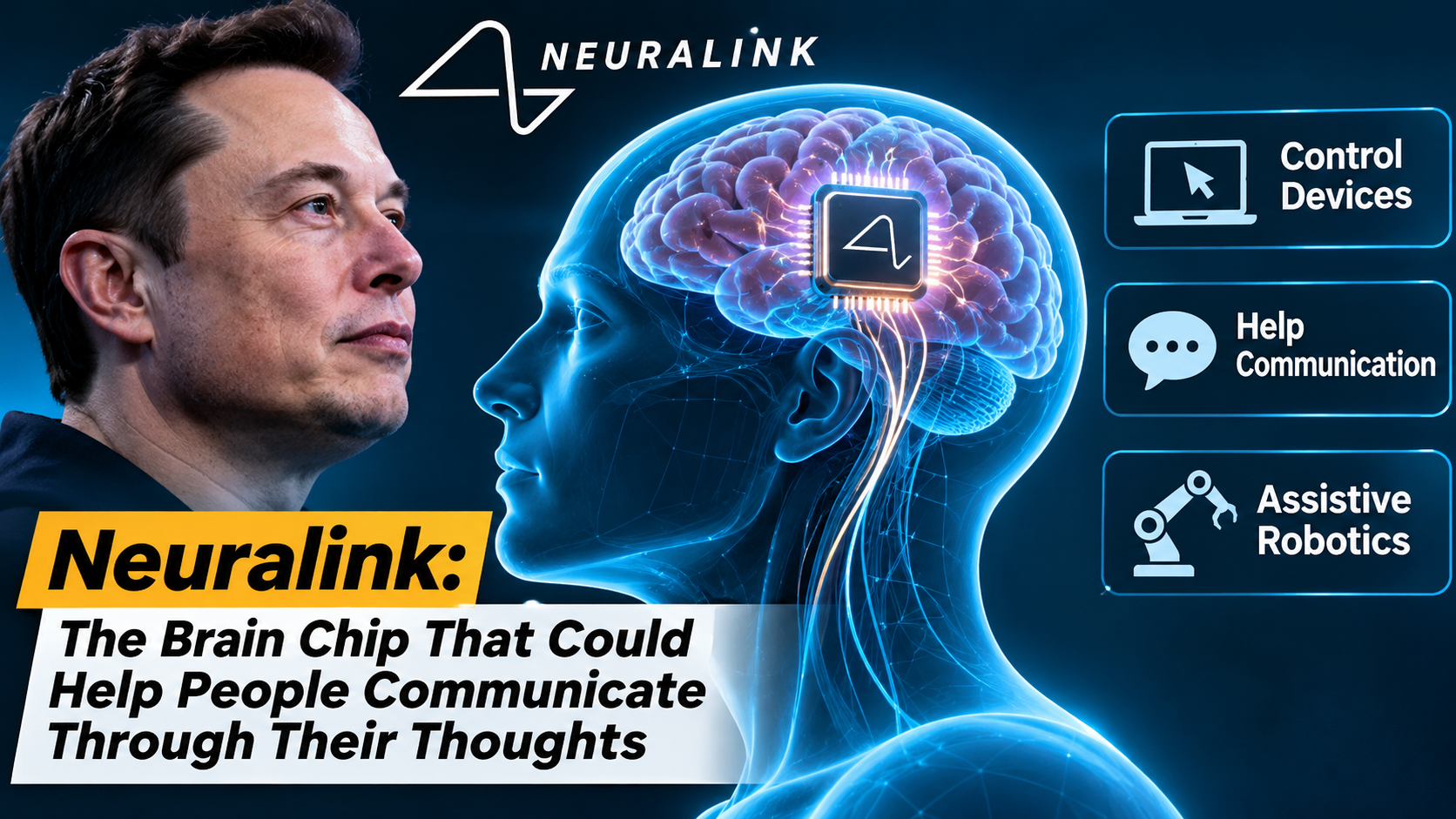
I first heard about this technology around 2024, when Elon Musk announced that Neuralink had successfully implanted its brain chip in a human for the first time. At that time, it sounded like something from the future.
However, the technology has continued to develop. More people have participated in clinical trials, and companies in China and other countries are also working on brain-computer interfaces.
What makes this technology interesting is its potential to help people who cannot speak or move normally. But how does it actually work, and how close are we to controlling computers through our thoughts?
Neuralink's First Human Trial
In January 2024, Elon Musk announced that the first human had received a Neuralink brain implant and was recovering well. The company later confirmed that the initial system could detect neural signals and allow the participant to interact with a computer.
Neuralink, a company co-founded by Elon Musk in 2016, had reached an important milestone by beginning its first human clinical trial, known as the PRIME Study.
The main idea behind this technology is a brain-computer interface, commonly known as BCI. It creates a direct connection between the human brain and an external computer, allowing a person to control certain devices using signals generated by brain activity.
This could be particularly helpful for people with paralysis or medical conditions that make communication and movement difficult.
Neuralink's progress has continued beyond its first participant. In January 2026, the company announced that 21 participants had received its implants as part of its expanding clinical research efforts.
This represents an important step in testing the technology with more people, although it remains an investigational medical device rather than an ordinary consumer product.
Telepathy: Controlling Devices With Your Thoughts
Neuralink's first product is called Telepathy. Its goal is to allow people with paralysis to control a phone or computer through decoded brain signals.
For example, imagine someone who cannot move their hands because of a spinal cord injury. Even simple activities, such as sending a message, browsing the internet, playing a game, or communicating with family, can become difficult.
With a brain-computer interface, the user can attempt to move a cursor by imagining a movement. The implanted system records relevant neural activity and translates it into commands that a computer can understand.
Neuralink's early participants have demonstrated the ability to control computer cursors, play video games, and interact with digital applications.
The technology has also moved beyond basic computer control. Neuralink's research has explored using its implant to control an assistive robotic arm, potentially helping people perform everyday activities that would otherwise require assistance.
In November 2025, the Barrow Neurological Institute reported that a participant in the CONVOY study had become the first person to use the Neuralink system to control an assistive robotic arm.
The goal is not simply to create a futuristic way of using technology. It is to provide people with severe movement limitations with more independence.
How Does the Brain Chip Work?
Neuralink's system uses a small implant called the N1 Implant. It contains electronics and very thin electrode threads designed to record electrical activity from neurons in the brain.
These neural signals contain information associated with intended movements. The implant records this activity and sends the information to a computer, where specialised software interprets the signals and converts them into digital commands.
The process can be understood in a few simple steps:
- Brain activity: Neurons produce electrical signals when a person intends to perform a movement.
- Signal detection: Tiny electrode threads record relevant neural activity.
- Signal processing: The implanted electronics process and transmit the recorded information.
- Computer interpretation: Software decodes the signals into commands, such as moving a cursor.
- Device control: The computer responds to the decoded commands.
The implantation procedure uses a specialised surgical robot called the R1 Robot. It is designed to place the extremely thin electrode threads into specific areas of the brain while avoiding blood vessels.
The N1 Implant is designed to be wireless and rechargeable. This means users do not need a conventional charging cable permanently connected to the implanted device.
Although the technology sounds complicated, the basic idea is straightforward: detect relevant brain signals, interpret them, and use the information to control an external device.
Can Neuralink Really Turn Thoughts Into Speech?
One of the most interesting possibilities of brain-computer interface technology is helping people who have lost the ability to speak.
For someone living with conditions such as amyotrophic lateral sclerosis (ALS), a stroke, or a severe spinal cord injury, communicating with other people can become extremely difficult.
Neuralink is working on a separate research programme called VOICE, which focuses on restoring communication for people with severe speech impairment.
The objective is to develop technology that can decode speech-related neural activity and convert intended words into text or spoken output through a computer.
In May 2025, Neuralink announced that its speech-related technology had received FDA Breakthrough Device Designation. This designation is intended to support the development and regulatory review of promising medical devices for serious conditions.
It is important to understand that this designation does not mean the technology has received FDA approval for general medical use.
In October 2026, Neuralink also shared early research on real-time communication restoration in people with ALS using an implanted speech brain-computer interface.
This research is particularly interesting because it moves beyond controlling a computer cursor and explores whether brain signals can help people communicate through text or speech.
However, this remains an area of clinical research. It does not mean that anyone can currently communicate freely by simply thinking any sentence.
Is Neuralink the First Company to Develop This Technology?
No. Brain-computer interfaces have been researched for decades, and the technology did not begin with Neuralink.
Researchers have already demonstrated that people can use brain signals to control computer cursors, robotic limbs, and other external devices.
Several organisations are working on different approaches to brain-computer interfaces. These include Neuralink, Synchron, academic research institutions, and companies developing less invasive systems.
What makes Neuralink different is its approach to capturing brain signals using multiple tiny electrode threads implanted directly into the brain, along with its specialised surgical robot.
Other companies are exploring different implantation methods. For example, Synchron is developing a system that can be delivered through blood vessels, avoiding the need for traditional open-brain surgery.
These different approaches highlight how researchers are trying to solve the same problem: creating a reliable connection between the human brain and external devices.
China Is Also Developing Brain-Computer Interface Technology
Neuralink is not the only company or organisation working on this technology. China has also been investing in brain-computer interface research and clinical development.
In March 2025, Reuters reported that Chinese researchers and NeuCyber NeuroTech were advancing human testing of a brain-computer interface called Beinao No.1.
The system was designed to help people with paralysis interact with computers and robotic devices. Unlike Neuralink's approach, Beinao No.1 uses electrodes positioned on the surface of the brain.
Chinese research teams have also been exploring invasive brain-computer interfaces. In June 2025, the Chinese Academy of Sciences reported on a clinical trial involving a man who had lost all four limbs and was able to play computer games using brain signals after receiving an implant.
China made another significant announcement in March 2026. Reuters reported that Chinese regulators had approved a brain-computer interface medical device for commercial use to help certain patients with paralysis regain hand-grasping ability.
This development shows that brain-computer interfaces are gradually moving beyond laboratory experiments and into medical applications.
However, different systems have different capabilities, implantation methods, and regulatory approvals. Their results should not be treated as directly interchangeable.
The Risks and Challenges of Brain Chips
Although brain-computer interfaces offer exciting possibilities, they also raise important medical, technical, and ethical questions.
1. Medical and Surgical Risks
Neuralink requires a surgical procedure to implant its device into the brain. Like other brain surgeries, this carries potential risks, including infection, bleeding, tissue damage, and complications associated with implanted hardware.
Researchers also need to understand how the electrode threads and surrounding brain tissue behave over many years.
2. Data Privacy and Security
Brain-computer interfaces collect sensitive neural information. Protecting this information is extremely important because it relates to a person's brain activity and health.
Developers must ensure that the systems have strong security protections, appropriate consent procedures, and safeguards against unauthorised access.
However, current Neuralink technology does not give someone the ability to remotely read every private thought or control another person's mind. It is designed to decode specific signals for defined tasks.
3. Long-Term Reliability
Another major challenge is making sure the implant continues working reliably over time.
Researchers need to evaluate electrode performance, signal quality, battery life, software updates, and the possibility of hardware complications.
4. Accessibility and Cost
Brain implants involve specialised surgery, medical facilities, engineering, and long-term support. Making this technology affordable and accessible to the people who need it will be another important challenge.
What Could the Future of Neuralink Look Like?
The future of brain-computer interfaces could extend beyond controlling computer cursors.
Some potential applications being explored by researchers include:
- Communication: Helping people with severe speech impairments communicate using decoded brain signals.
- Computer control: Allowing people with paralysis to operate computers and smartphones.
- Assistive robotics: Controlling robotic arms and other assistive devices to perform everyday activities.
- Gaming and entertainment: Exploring new ways to interact with games and digital environments.
- Vision restoration: Researching whether brain implants could eventually help people with certain forms of vision loss.
Some of these applications are already being investigated in clinical studies, while others remain long-term research goals.
For now, the strongest medical motivation behind this technology is restoring communication and independence for people with serious neurological conditions.
Final Thoughts
Neuralink's brain chip represents an important development in the technology connecting the human brain with computers.
What once sounded like science fiction is now being explored through human clinical trials. Participants have demonstrated computer control using neural signals, and researchers are investigating how similar systems could help people communicate and operate assistive devices.
However, the technology is still developing. Questions about surgical safety, long-term reliability, privacy, affordability, and regulatory approval need careful attention.
For people who cannot speak or move easily, brain-computer interfaces could eventually open new possibilities for independence and communication.
The biggest achievement of this technology may not be allowing healthy people to control computers with their thoughts. It could be giving people who have lost the ability to communicate a new way to connect with the world.
The big question is no longer simply whether humans can connect their brains to computers. It is how far this technology can go, who will benefit from it, and how responsibly it will be developed.
Disclaimer: Neuralink's implants are investigational medical devices being evaluated through clinical trials. They are not generally available consumer products or established treatments for all forms of paralysis or speech impairment. Clinical outcomes and future applications are still being studied. This article is for informational and educational purposes only.
Sources and Further Reading
- Neuralink – A Year of Telepathy (February 5, 2025: First human implant, early participants, and progress with device control)
- Neuralink – Two Years of Telepathy (January 28, 2026: Participant progress and developments in brain-computer interfaces)
- Neuralink – Official Updates and Research (Latest engineering developments, clinical research, and speech-restoration updates)
- Neuralink – Device Control Clinical Trials (PRIME and CONVOY studies, N1 Implant, and robotic-arm research)
- Neuralink – Speech Restoration Research (VOICE study and research into converting intended speech into text or spoken output)
- US Food and Drug Administration – Breakthrough Devices Program (Explanation of the regulatory designation and medical-device review process)
- Reuters – Chinese Brain Chip Project Speeds Up Human Trials After First Success (March 31, 2025: China's Beinao brain-computer interface research)
- Chinese Academy of Sciences – Chinese Research Team Launches Clinical Trial for Invasive Brain-Computer Interface (June 16, 2025: Human clinical research involving computer control through brain signals)
- Reuters – China Approves Market Launch of Brain-Computer Interface Medical Device (March 13, 2026: Report on China's regulatory approval of a BCI medical device)
Sources are provided for informational purposes and further reading. Company announcements describe their own research and should be distinguished from independently verified clinical evidence. Information reflects developments available as of November 3, 2026.


